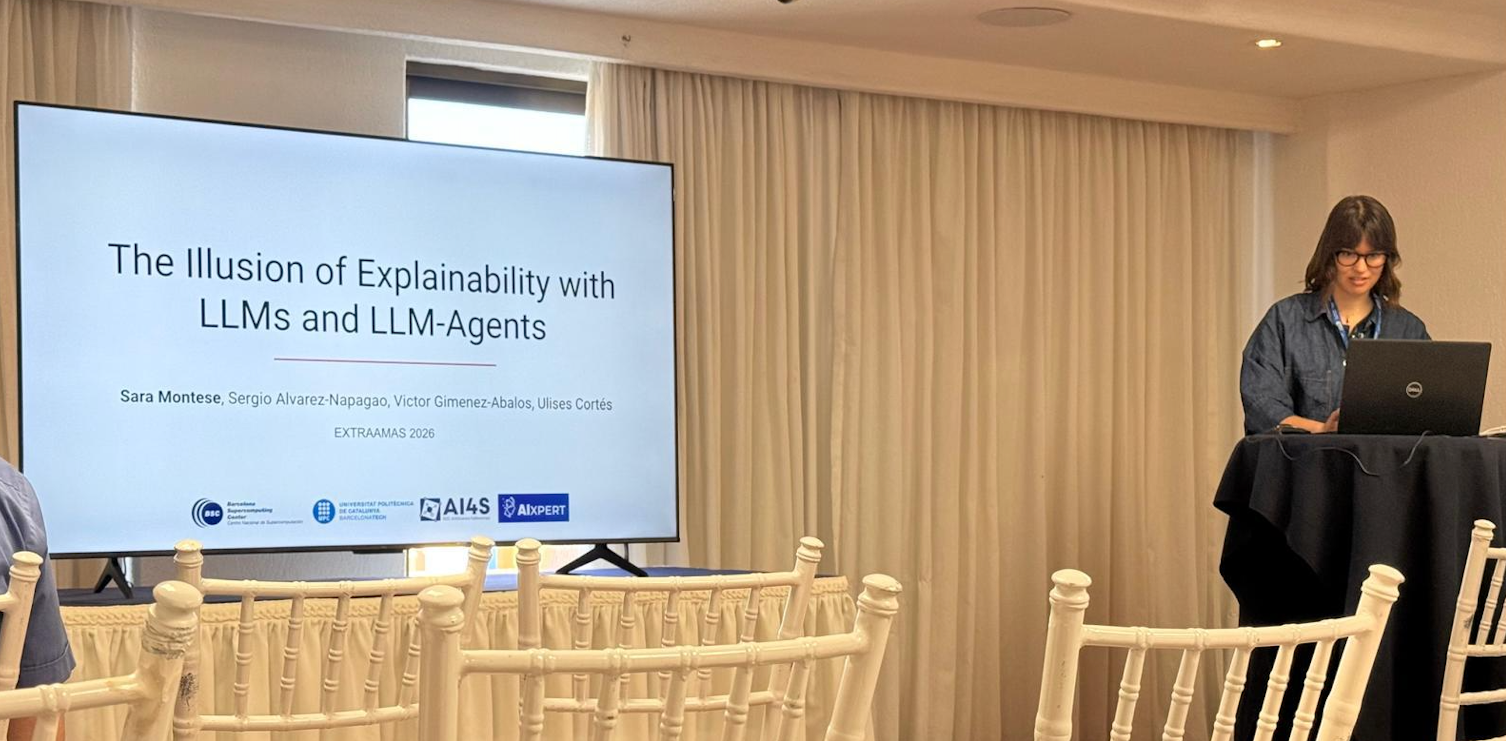
As autonomous agents take on increasingly complex decision-making roles, understanding and interpreting their behaviour becomes more challenging. In May, the Barcelona Supercomputing Centre organised a tutorial introducing a structured, agent-focused perspective on explainability, moving from commonly used post-hoc techniques to more expressive causal and intention-aware forms of explanation.
The session blended conceptual foundations with hands-on illustrations. It started with widely adopted methods such as SHAP and LIME, discussing why they are frequently used in practice and where they can be misleading when the goal is to explain behaviour rather than surface-level correlations. From there, the tutorial expanded toward causal, contrastive, counterfactual, and higher-level behavioural explanations that better capture the reasoning behind agent actions.
Instead of promoting a single approach, the tutorial laid out a broader map of explainability techniques for autonomous agents, highlighting their assumptions, strengths, and limitations.
Key Topics Covered
Participants explored:
- The distinction between ante-hoc and post-hoc explainability in agent systems
- Practical use of feature-based methods (SHAP, LIME) for explaining agent behaviour
- Limitations of post-hoc approaches in capturing causal structure
- Contrastive and counterfactual explanations as alternatives to correlation-based methods
- Shifting explanatory scope from local actions to global behaviour and goals
- Matching explanation methods to different types of stakeholders and explainees
You can find more information on the tutorial here.