
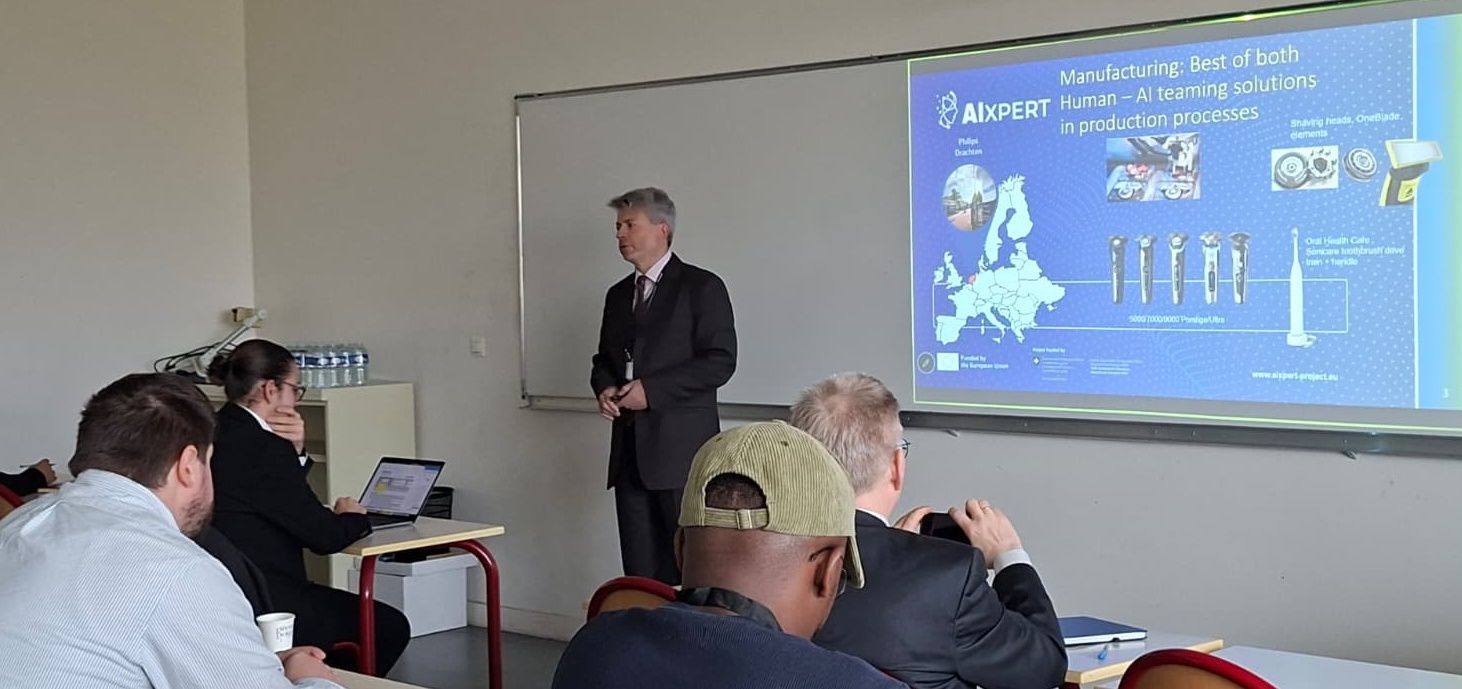
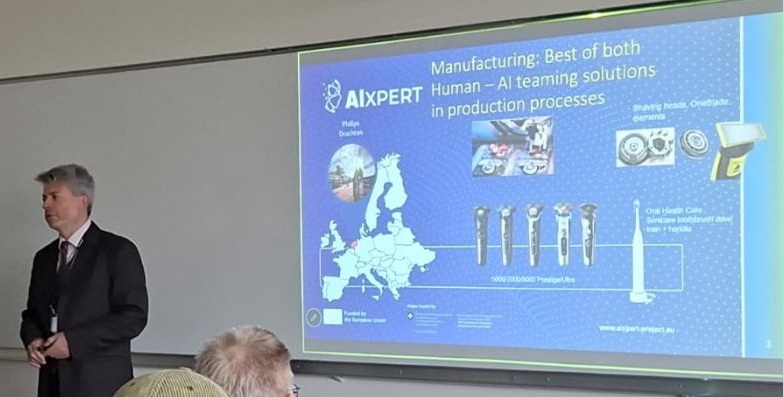
Agentic AI is moving from the lab onto the factory floor. At the 7th IFAC/INSTICC conference on Innovative Intelligent Production and Logistics (IN4PL 2026) on 29-30 October 2026 in Angers, France, the University of Groningen showed what it takes to make that move trustworthy, with an opening keynote and an AIXPERT study on AI support for maintenance technicians.
When a production line stops, every minute counts. A technician facing an unfamiliar fault often has a thick binder of procedures, a fault code and little time. AI assistants that can read those procedures and talk a technician through a maintenance action recommendation are an obvious promise. But in a factory, an answer that merely sounds right is not good enough: the steps must be the right ones, in the right order, and tailored to the context of the moment.
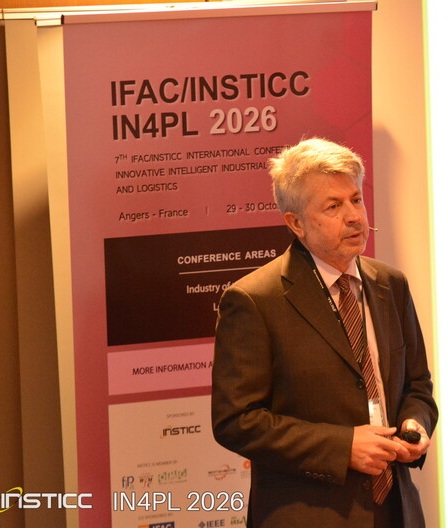
That tension ran through the contributions of Christos Emmanouilidis and his colleagues at the University of Groningen (RuG), one of the AIXPERT partners, at IN4PL 2026 on 29 and 30 October. Christos gave the conference’s opening keynote and presented challenges for AI automation in manufacturing plants, as well as research carried out within AIXPERT, the Horizon Europe project developing transparent, trustworthy and auditable agentic AI.
Trust is a feeling; trustworthiness can be checked
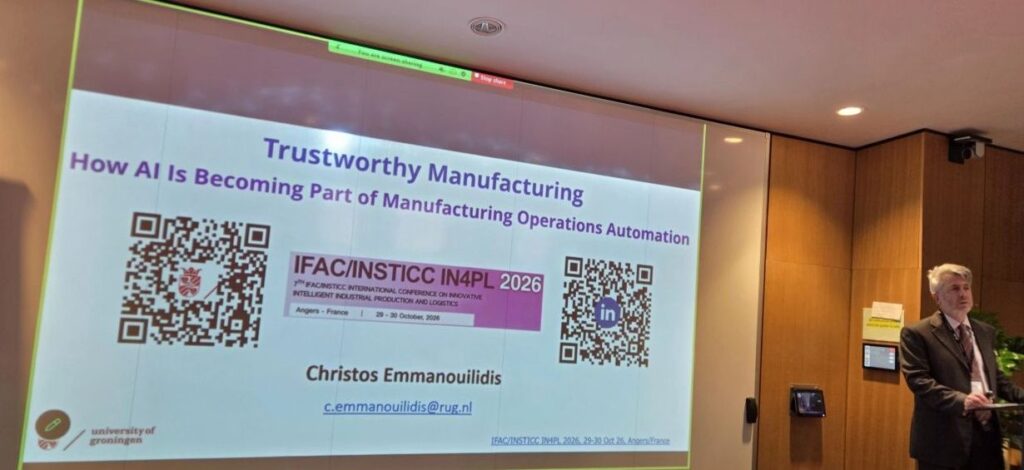
The keynote, Trustworthy Manufacturing: How AI Is Becoming Part of Manufacturing Operations Automation, started from a distinction that is easy to miss. People may trust a system for many reasons. Trustworthiness, as Christos put it in his abstract, “is a quality property of systems and is about meeting stakeholders’ expectations in a verifiable way.”
That distinction matters more as AI changes character. Classic factory automation follows fixed rules, so its behaviour can be specified and tested in advance. Agentic AI systems can plan, use tools and act with a degree of autonomy. They are more flexible, but also less predictable, which makes trustworthiness a central industrial risk rather than an academic concern.
The keynote covered:
- the performance expectations placed on manufacturing operations management;
- the industrial transition towards AI-driven production;
- the potential and the challenges of agentic AI and AI automation;
- how human roles are changing, and what teams of people and AI agents can achieve together;
- the role of AI standards in future-proofing AI-enabled production.
The examples came from human-AI teaming research at the University of Groningen’s Faculty of Economics and Business and its Jantina Tammes School of Digital Society, Technology and AI, across several European projects including AIXPERT.
When "relevant" is not the same as "correct"
The second contribution brought these ideas down to a concrete industrial task. The paper Procedural Correctness in AI-Supported Maintenance Troubleshooting: A Comparison of Embedding-Based and Hybrid Retrieval, by Wessel J. Reuvers, Guillermo Gil de Avalle, Laura Maruster and Christos Emmanouilidis, grew out of Wessel’s MSc thesis, carried out during an internship at Philips in connection with AIXPERT.
Its starting point is a weakness in how many AI assistants find information. Most use semantic retrieval: they convert text into numerical representations, called embeddings, and fetch the passages whose meaning is closest to the question. That works well for general questions. But in Standard Operating and Maintenance Procedures, the passage that sounds most similar to the technician’s question is not necessarily the right step to take next.
“Semantic relevance is not enough for AI operator support in Standard Operating and Maintenance Procedures,” Christos summarised.
The study compared purely embedding-based retrieval with hybrid approaches, judging both the quality and the correctness of the support given to maintenance personnel. Its conclusion is that procedural alignment, meaning where a step sits in a procedure and what must come before it, has to be added to semantic retrieval. The team tested several large language models, and also examined how ambiguity in the way people phrase their questions affects the quality of the retrieved information and the advice generated.
Why it matters beyond the lab
For manufacturers, the message is practical. An AI assistant on the shop floor will only be adopted, and only be safe, if technicians, maintenance managers and auditors can see that its advice follows the approved procedure. Measuring procedural correctness, not just relevance, gives companies a way to check that before an assistant reaches a real machine.
The work also feeds a public resource. In parallel, the RuG team led by Guillermo Gil de Avalle developed DiagFlowBench, a benchmark for testing how language models handle diagnostic dialogues that follow a flowchart. It contains 50 anonymised diagnostic flowcharts inspired by real maintenance documentation, covering faults such as conveyor tracking, vision inspection, robotic placement and machine spindle checks, together with 1,676 simulated conversations between operators and an AI agent. It tests whether a model follows the procedure step by step, and whether it recognises when an operator’s input falls outside it.
Both contributions reflect what AIXPERT sets out to demonstrate: agentic AI grounded in verifiable sources, such as standard operating and maintenance procedures, and tested and benchmarked for its trustworthiness. The manufacturing work is one of several AIXPERT use cases, alongside healthcare, recruitment, music and human-robot interaction.